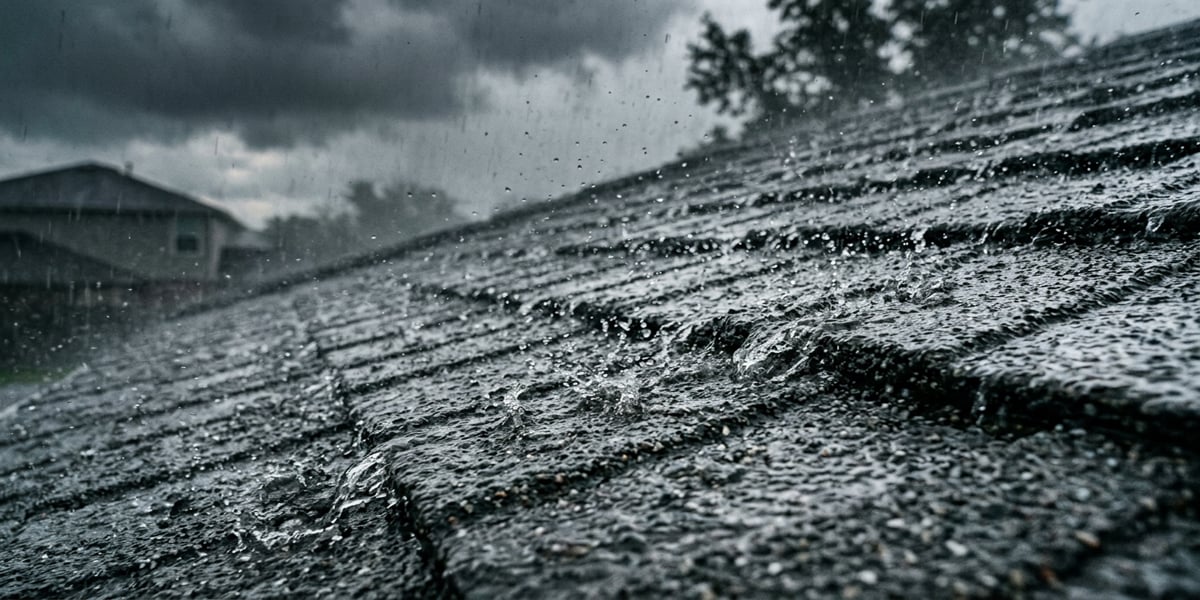
Homeowners on roofing material for a remodel often gravitate towards metal roofing for its longevity and weather protection. But they may wonder, “Are metal roofs loud when it rains?”
That’s a legitimate question, especially if you’ve experienced old-fashioned noisy tin roofing.
Fortunately, metal roofing is not loud in the rain when you choose the right roofing product and install it properly. Learn how to choose a quiet metal roof with this guide.
Metal Roofing Has Changed Over the Years
When you think of metal roofing, you may imagine industrial-style corrugated roofing or flat metal sheets laid over a barn or warehouse. Some types of metal roofing can be loud. It’s due to a combination of the roofing material itself and the architecture of commercial and agricultural structures (more on that below).
But metal roofing has come a long way since its introduction to the residential market. A key innovation was the addition of exterior stone coating. Sheets of steel are first stamped into different profiles resembling traditional tiles, shakes, and shingles. Then they are painted in hues to match different paint schemes and architectural styles. Finally, a layer of stone granules is added to the surface.
The stone granules not only add texture for curb appeal, but also enhance it. They help prevent snow and ice from sticking to the roof. And they absorb a significant amount of sound.
In general, thicker metal and metal with some light texture tend to be more soundproof. In contrast, a sheet of thin, flat metal stretched over a roof will be noisier.
Some top-performing stone-coated metal roofing is manufactured with a hollow core. This helps keep the roof's surface temperature more stable, preventing freeze-thaw cycles that can lead to ice damming. As you might imagine, it also adds a damping effect, making the roof even quieter during a rainstorm. Reducing thermal expansion and contraction also reduces noise from roofing stress points at various fasteners.
.jpg?width=960&name=DECRA_Coated_vs_Uncoated_Metal_Roof-960w%20(1).jpg)
How Metal Roofing on a Home Differs from Other Installations
When you heard noisy metal roofing in the past, where was it? It was probably in an industrial setting or perhaps on a farm. That type of roofing is installed quite differently, however, from metal roofing on a home.
In most commercial and agricultural scenarios, metal roofing is installed over a bare framework. This transmits sound much more readily, making the roof sound louder.
But residential metal roofing is installed over a solid substrate for a more complete roof assembly. First, there is the roof decking, which is typically a plywood or oriented strand board (OSB) base layer. The composition of this wood layer prevents vibrations from metal roofing from traveling down the rafters into the home.
There may be a fabric underlayment installed above the decking. This acts as a second water barrier on the roof. Then the metal roofing is added as the top layer, often on battens (a wooden grid) that provide even more noise protection.
Plus, below the roof, there is soundproofing in your home. Your attic or upper story likely has insulation. And there may be a ceiling below that. It all combines to reduce the noise produced by rain hitting the roof.
This noise insulation can be calculated. Studies show that rain hitting a modern metal roof is barely louder than rain striking asphalt shingles, the most commonly used roofing material in the US. Rain over metal roofing on a solid deck measures about 52 decibels, compared to 46 decibels registered with shingles. As a point of reference, 50 decibels is about as loud as a quiet conversation or the hum of a refrigerator.
How to Add More Soundproofing to Your Home’s Upper Level
If you feel you want even more quiet in your home, there are a few ways to increase soundproofing:
- Inspect your roof regularly to make sure nothing is loose. This should be done in the spring and fall, as well as after any major storms. Loose roofing material, flashing, or ventilation can contribute to noise in rain and wind.
- Always use a qualified contractor for roof repairs and roof remodeling. An experienced and knowledgeable contractor knows how to account for a small amount of natural thermal movement in a metal roof without overtightening. They know how to install all the roof components properly, so nothing comes loose or bangs around in a storm.
- Add insulation, which is particularly easy to do during a roof remodel. You can use closed-cell spray foam insulation directly beneath the roof deck to create a dense sound barrier. Another option is to beef up wool or fiberglass attic insulation. This further minimizes the sound path between the roof and the home’s interior.
- You can ask your contractor about using a specialized acoustic underlayment. This material is made of rubber or synthetic material and dissipates impact energy before it can be transmitted from the roof surface to the roof decking.
DECRA Metal Roofing Gives You Quiet Weather Resistance
DECRA stone-coated metal roofing offers outstanding soundproofing from rain on your home. But it also provides stellar weather resistance against hail impact damage, wind-driven rain, and wind uplift. And it carries the highest possible fire rating from Underwriters Laboratories (UL).
Metal roofing lasts up to three times longer than traditional roofing options and provides homeowners with significant savings on summer cooling costs and insurance premiums.
DECRA gives you a choice of colors and shingle, shake, or tile profiles to perfectly match your home’s style. You can see how stone-coated metal roofing works up close by requesting a complimentary DECRA sample today.